Homeownership on the Edge: Truework 2026 Recent Homebuyer Report

Download the full report here.
Overview
Homeownership today is forcing painful financial trade-offs and putting recent buyers at risk
Recent homebuyers are gambling on future rate cuts. To achieve the “American Dream” of homeownership, many are making major sacrifices in their daily budgets now, betting that rates will drop later. But that bet isn't sustainable over the long term, and first-time buyers and Millennials are especially vulnerable to job loss or an unexpected emergency expense.
This is the central finding from Truework’s latest report, which surveyed 1,000 Americans who purchased a home within the past 24 months. Most analysts don’t expect a major rate cut anytime soon, and the gap between buyers' expectations and market reality could cause ripple effects across the broader economy.
Mortgage payments are forcing many recent homebuyers into real financial risk just to stay in their homes. Here are the highlights:
- 88% of recent buyers with a mortgage say one common financial setback could jeopardize their ability to make their monthly payment
- 85% of recent homebuyers with a mortgage say refinancing within the next three years is important to their financial health, up from 56% in a similar 2025 survey
- 67% say job loss or a reduction in income would put their mortgage payments at serious risk
- 50% say their mortgage becomes unsustainable without a lower rate
- 40% say they will need to get a second job if they are not able to refinance their mortgage in 3 years – and 21% would dip into retirement savings in that same scenario
- 32% have already cut back on basic living expenses like food, clothing, health, and hygiene to cover their mortgage today
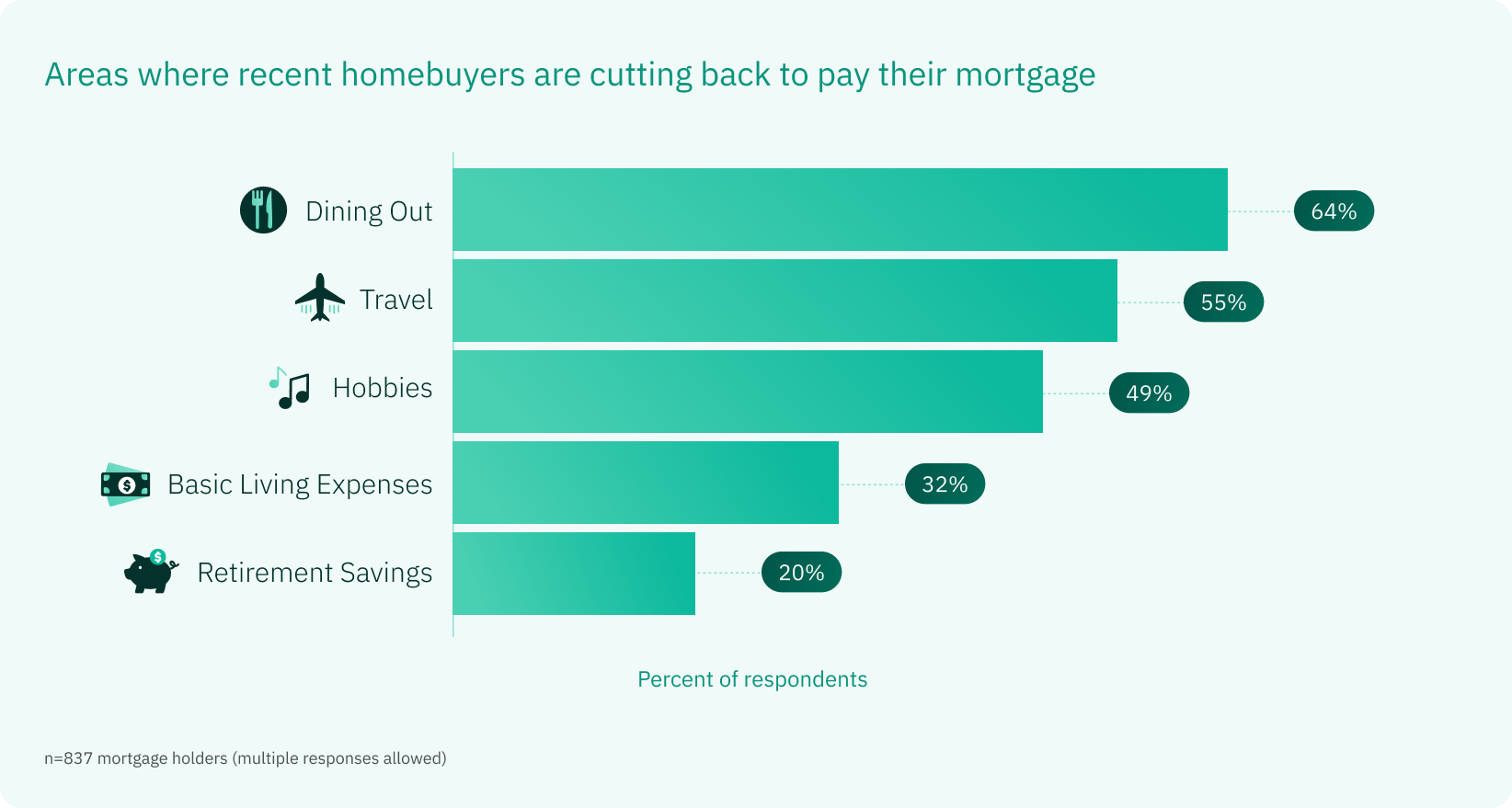
More than half of recent buyers have cut back on “extras” like dining out and travel. Around one-third (32%) are going further, dialing back basic living expenses like food, clothing, health, and hygiene.
- 32% have cut back on basic living expenses to cover their mortgage*
- 46% may need to cut spending significantly if they can't refinance within 3 years*
- 50% say their mortgage becomes unsustainable without a lower rate*
(*Among recent homebuyers with a mortgage)
But how did today’s buyers get here? Many recent homebuyers purchased at rates between 6-7%, never expecting that rate or monthly payment to be permanent. Nearly three in four (73%) mortgage holders said they planned to refinance as soon as rates gave them room to breathe.
We’re calling this “Conditional Affordability”: a payment that works today, but only through continued financial sacrifice, and long-term finances that depend, at least in part, on a future rate drop.
Truework’s analysis found that how much a buyer’s finances depend on rates falling often predicts financial strain better than income, age, or first-time buyer status, making rate expectations a signal worth watching even for buyers who look financially secure on paper.
The rest of this report explores “Conditional Affordability” in depth, along with what these findings mean for the state of homeownership in America today. Download the full report here.
The Current State
Recent buyers are making painful financial concessions to pay their mortgage
Recent buyers are making financial concessions and reshaping everyday budgeting decisions to maintain their monthly mortgage payments.
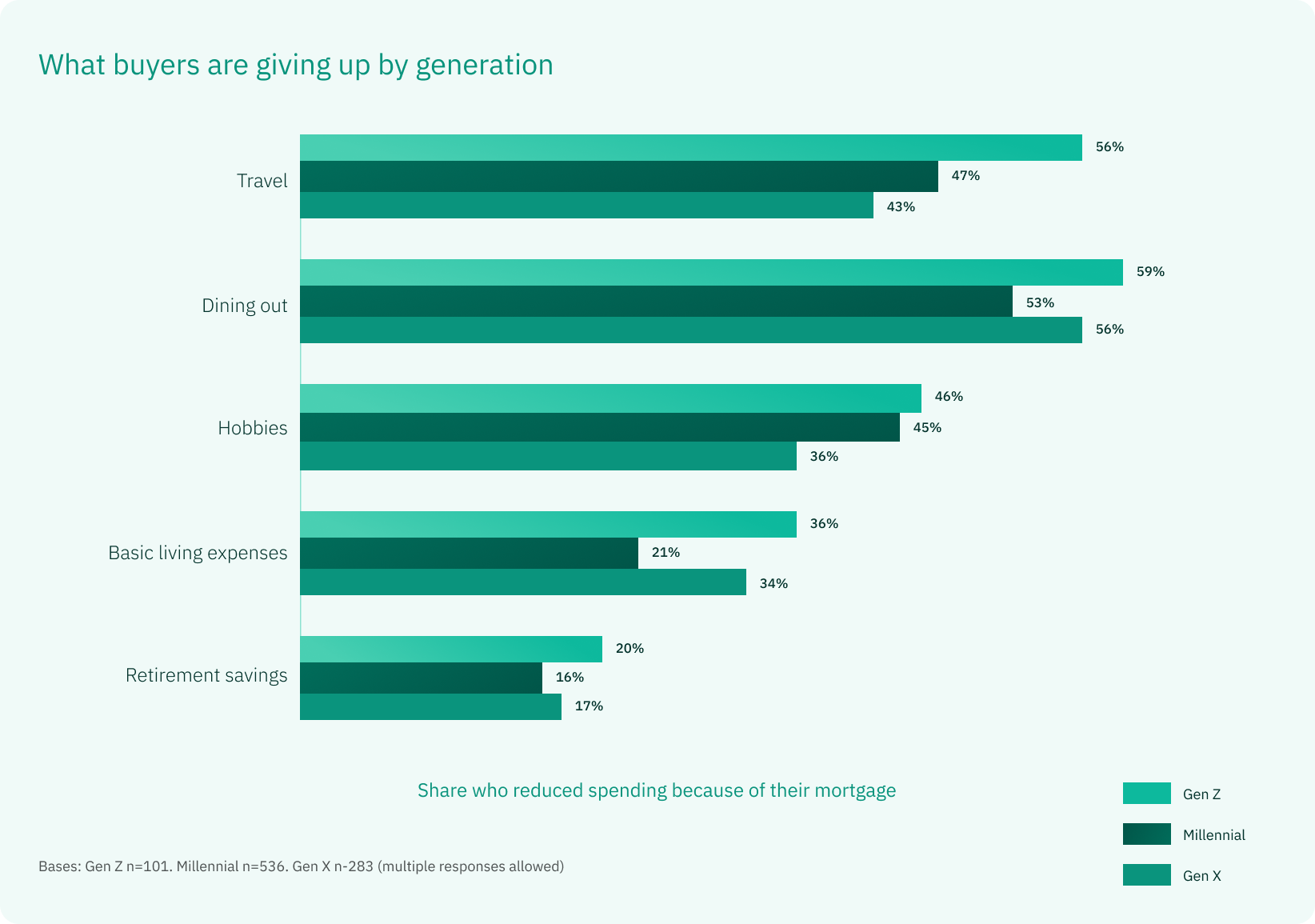
While the expected areas of dining out (64%), travel (55%), and hobbies (49%) are the first to go for many mortgage-holding households, the financial strain is reaching essentials, too. Nearly one-third (32%) of homebuyers have scaled back on basic living expenses, and one in five (20%) are even cutting back on retirement savings contributions. This tells us that housing costs are affecting not just buyers’ lifestyles, but also their financial security and day-to-day essential needs.
Recent buyers are especially vulnerable to ordinary financial shocks
Today’s buyers aren’t just cutting expenses to stay in their homes. In many cases, they’re also exposed to greater risk of disruption to income or unplanned costs, from home repairs to medical bills. Two-thirds (67%) say job loss or a reduction in income would put their ability to pay their mortgage at serious risk. Additionally, 44% of buyers said unexpected medical expenses could jeopardize their mortgage payments, and 42% of recent buyers said a major home repair could put their house payments at risk.
- 88% of recent mortgage holders say that at least one common financial shock could jeopardize their ability to make their monthly payments
- 67% of recent homebuyers say that job loss or a reduction in income would put their ability to pay their mortgage at serious risk
Mortgage costs are delaying major life decisions for many buyers
Homeownership has traditionally been treated as a milestone that creates stability. But for some recent buyers, the cost of maintaining that milestone is delaying the next one. Respondents said that mortgage costs are influencing work, family formation, retirement, and entrepreneurship. Among mortgage holders who have already cut spending:
- 17% have considered delaying a job change
- 16% have considered delaying starting a business
- 14% have considered delaying retirement
- 13% have considered delaying having children
Buyers are bracing for tougher trade-offs if rates don’t fall
With all the sacrifices and spending cuts recent buyers are making, it’s perhaps not surprising that 85% of recent mortgage holders said refinancing within 3 years is important to their financial health. That’s a sharp jump from the 56% of new buyers who said the same in last year’s study. In fact, 50% of today’s buyers said their mortgage will become financially unsustainable if they can’t refinance soon.
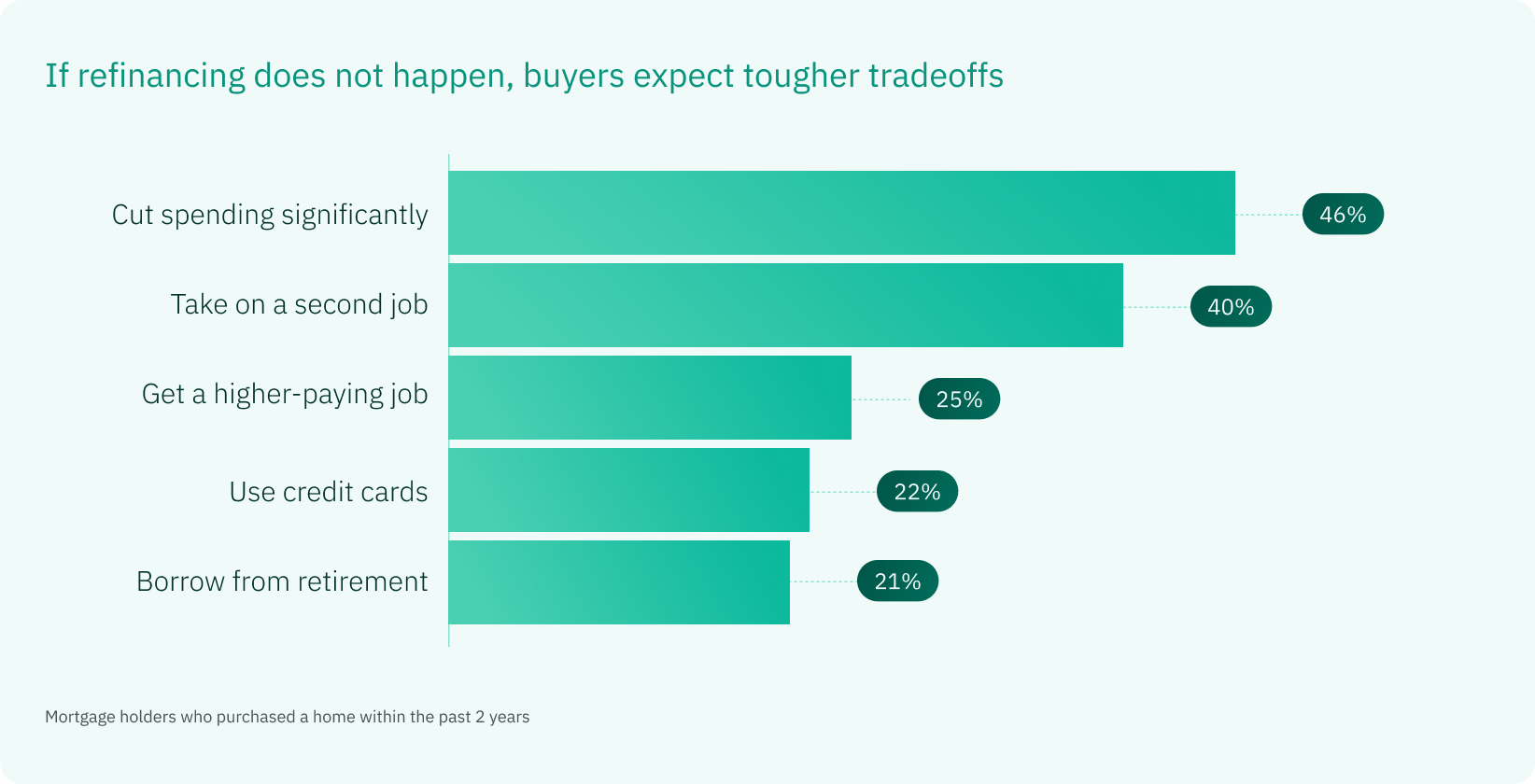
Many buyers say they're prepared to make tough trade-offs and sacrifices. Asked what they’d need to do without refinancing, most mortgage holders named at least one major response: cutting spending was the most common (46%), followed by taking on more work (40%). A quarter (25%) said they’d need a higher-paying job, 22% would turn to credit cards, and 21% would borrow from retirement savings, something most finance professionals strongly advise against.
How Buyers Got Here
Many buyers purchased with a refinance already in mind
The idea behind “date the rate, marry the house” was simple: buy now, then refinance when rates fall. For many recent buyers, that was not just a slogan: it was part of their financial plan. Especially when 73% planned to refinance eventually when they bought their home.
That expectation is now central to how many recent buyers view their home’s affordability. Eighty-five percent say refinancing within the next three years is important to their financial health, and half (50%) admit that without a lower rate, it ’s only a matter of time before their monthly payment becomes financially unsustainable.
This is where Conditional Affordability starts to show up. The mortgage may be payable today, but for many buyers, the long-term math depends on something changing: rates falling, income rising, or the household continuing to cut back elsewhere.
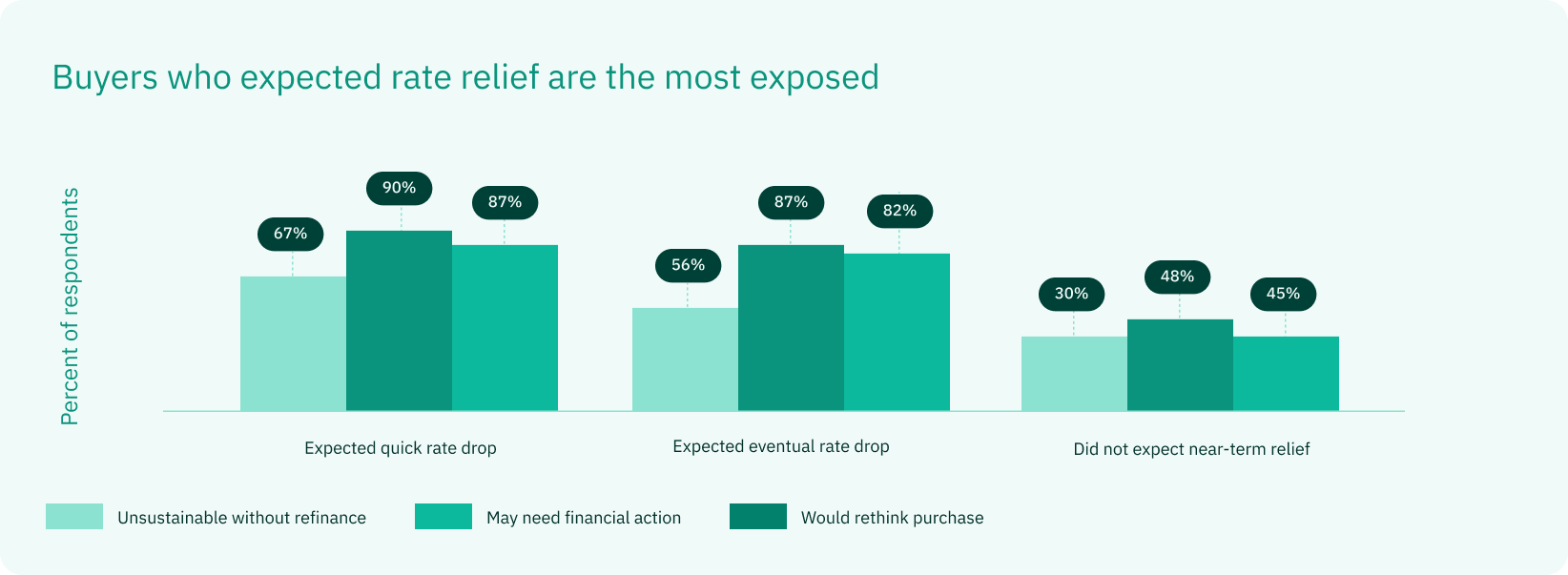
Expectations about rates are one of the clearest dividing lines. Buyers who expected rates to fall are much more likely to say they’ll struggle if that relief doesn’t arrive, a pattern that holds even after accounting for income, age, gender, region, parent status, marital status, first-time status, and purchase timing.
In other words, the buyers most exposed aren’t the lowest-income or newest buyers. If lower rates fail to materialize, the most financially exposed are the buyers who treated their initial mortgage payments as temporary.
The refinance gamble is fueling buyer’s remorse
The refinance gamble also changes how recent buyers look back on their home purchase. If mortgage rates remain where they are today or rise over the next two years, three in four mortgage holders (75%) say they would reconsider at least one part of their home purchase:
- 37% would have waited longer to buy
- 31% would have purchased a less expensive home
- 22% would have chosen a smaller home or moved to a different area
The findings reveal a striking paradox: many recent buyers are cutting spending, delaying financial goals, and rethinking parts of their purchase, yet very few say they regret becoming homeowners. For many Americans, owning a home remains important enough to justify financial sacrifices that might have seemed unreasonable just a few years ago.
- 75% of mortgage holders would rethink at least one part of their purchase (e.g. size of home, location, timing) if rates stay high
The Refinance Bet
Only 1 in 5 recent buyers feels financially secure without a rate cut
Truework analyzed response-level behavior and attitudes among recent buyers with a mortgage, identifying four distinct approaches to refinancing and managing the monthly payment. Just 20% land in the most secure group, meaning 4 in 5 recent buyers are betting some part of their financial future on a lower rate.
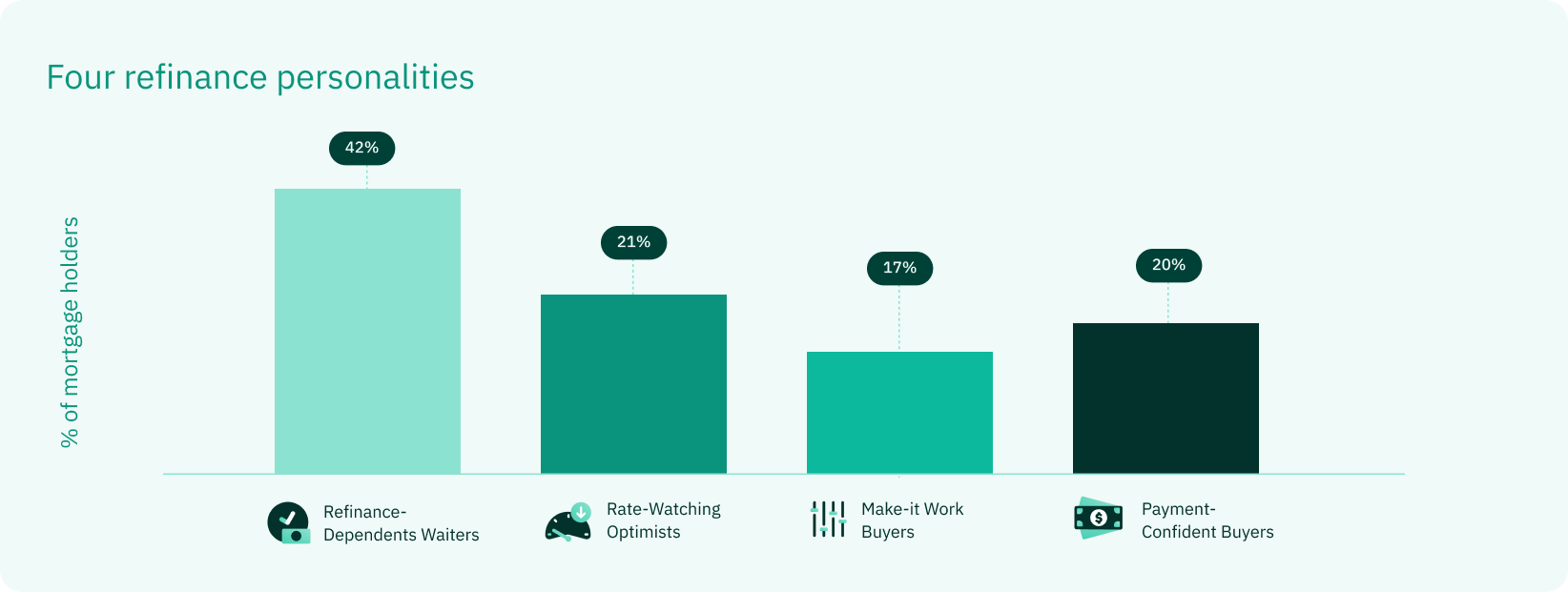
Let’s meet the refinance personalities and how they are coping
- Refinance-Dependent Waiters (42%): This is the largest segment: buyers who bought a home expecting rates to fall eventually, and are still waiting. Sixty-five percent say their mortgage payment will become unsustainable without refinancing. Nearly half (48%) say they may need to get a second job, and 60% might need to cut spending significantly.
- Rate-Watching Optimists (21%): This group expected rates to fall quickly and monitors them closely. Nearly three in four (74%) check interest rates at least once a week. They’re the most likely to have used an ARM, points, an assumable mortgage, or a longer loan term to get into a home. Even so, 74% still say the payment may become unsustainable without refinancing, meaning their close attention to rates hasn't translated into more financial confidence.
- Make-It-Work Buyers (17%): Rather than betting on rates, this group is adjusting their finances and household budget to make the payment work regardless of what happens with refinancing. That approach pays off: just 23% say the payment may become unsustainable, far lower than the Waiters or Optimists, even though a comparable share are cutting spending (69%) or considering a second job (52%).
- Payment-Confident Buyers (20%): This is the least strained group. Ninety-eight percent don’t expect to take major financial action if refinancing doesn’t happen, and 68% wouldn’t rethink their purchase. Only 15% say the mortgage may become unsustainable.
Who else is exposed?
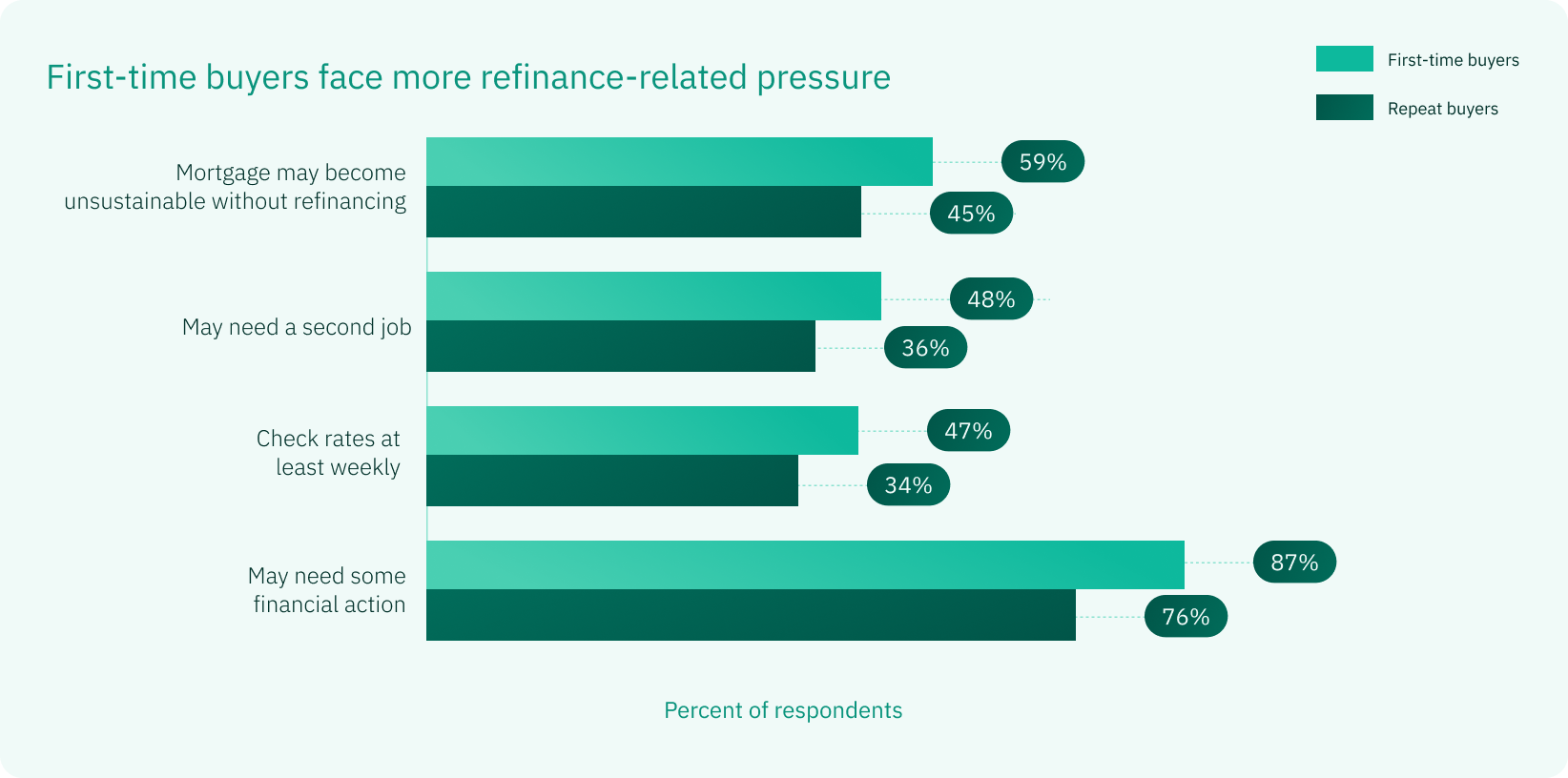
Beyond these four profiles, one group stands out regardless of which camp they fall into: first-time buyers. After accounting for income, age, family status, and other measured characteristics, they remained the most exposed to financial strain. Eighty-seven percent said they may need to take some financial action if they cannot refinance, compared with 76% of repeat buyers. First-timers also put more weight on refinancing itself: 89% called it crucial to their financial health within the next three years.
- 12 PTS: Adjusted mortgage unsustainability is 12 percentage points higher among households earning under $100,000 than among those earning $100,000 or more
Millennial buyers are betting most heavily on what happens next
Most Millennials aren’t first-time buyers trying to break into the market. In this survey, 68% of Millennial recent homebuyers had purchased a home before. Yet, even with prior experience, Millennials were more likely than older buyers to enter their latest home purchase expecting a rate drop.
Two-thirds of Millennials (66%) expected mortgage rates to fall, compared with 53% of Gen X buyers and 39% of Boomers. They were also twice as likely as Gen X buyers to take out an adjustable rate mortgage (18% vs. 9%). More than three in four (79%) Millennial mortgage holders said they planned to refinance when they bought their home. This suggests Millennials weren't just buying homes; they were buying into a future version of the payment.
Today, as rate relief remains uncertain, Millennials appear more exposed. More than half (53%) say their mortgage could eventually become financially unsustainable without refinancing, and 42% check mortgage rates at least weekly.
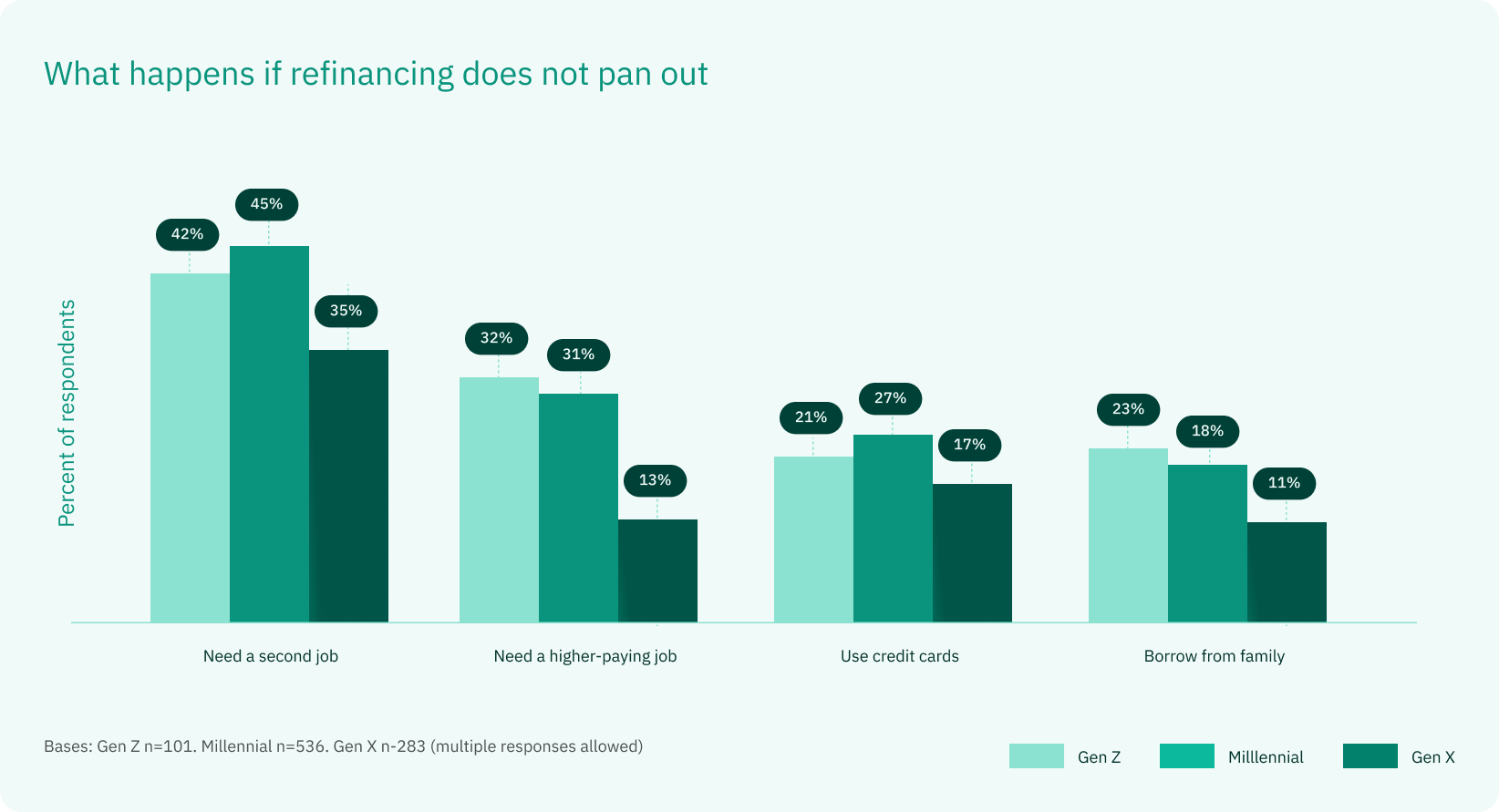
If they can’t refinance, Millennials are more likely to expect they’ll need to increase their income or rely on credit to keep up with their payment:
- 45% may need a second job or side hustle
- 31% may need to get a higher-paying job
- 27% may need to use credit cards to pay their expenses
The Millennial story isn't about naivety. Most had bought a home before, and they still chose to gamble on a rate cut that hasn't come. Now, with no relief in sight, they're the generation most likely to work a second job, take on debt, or delay major life decisions, like having children, to make the bet pay off, all in a market where the old American dream of buying a starter home is nearly impossible.
What This Says About Homeownership in 2026
Qualification is not the same as durable affordability
Most conversations about housing affordability focus on getting into a home: whether a buyer can complete the purchase, given home prices, interest rates, and inventory. This survey examines what happens after a buyer closes on their home and the ongoing trade-offs they make to keep payments manageable.
Many recent buyers made the numbers work at closing by compromising on the home (88%) or increasing the down payment (52%), or even borrowing from friends and family (16%). But for 73%, the math also depended on something that hadn’t happened yet: a future refinance. For some, that plan may still work. But today, a large share are living in the gap between the payment they currently have and the payment they expected to have later.
- 50% of mortgage holders say that without refinancing to a lower rate, their mortgage will eventually become financially unsustainable
- 38% check mortgage rates at least weekly
This has resulted in a form of Conditional Affordability: a household may be able to make the mortgage payment today, but only by cutting elsewhere or by believing that rates, their income, or their circumstances will change in the near future.
A home’s true cost doesn’t end at closing. For millions of recent buyers, it’s still being paid down in delayed milestones, second jobs, and shrinking margins, long after the keys are handed over.
Conditional Affordability isn't a temporary side effect of a high-rate market. Instead, it's a structural risk sitting inside millions of recent mortgages. For buyers, the takeaway is blunt: a payment you can make today isn't the same as a payment you can sustain for the next five years, and betting on a rate cut is a financial plan, not a guarantee. For lenders and underwriters, it's a signal to look past debt-to-income ratio at closing and ask how much of a borrower's long-term plan depends on refinancing because today's qualified buyer can be tomorrow's default risk if rates don't move. And for policymakers, it reframes the affordability conversation: expanding access to homeownership means little if the "in" comes with a hidden asterisk that could destabilize household finances — and, at scale, the broader housing market — the moment relief fails to arrive. Download the full report here.
Methodology
About this research
The Truework Survey was conducted by Wakefield Research among 1,000 nationally representative U.S. recent homebuyers between May 22 and June 4, 2026, via email invitation and online survey. “Recent homebuyers” are defined as U.S. adults who purchased a home within the past 24 months. For the full sample, the margin of sampling error is plus or minus 3.1 percentage points at the 95% confidence level. Results may not sum to 100% because of rounding. Questions that allowed multiple responses may total more than 100%.
Questions about refinancing, mortgage sustainability, and certain payment strategies were asked only of respondents who had a mortgage for their most recent purchase. That group included 837 respondents. Questions about delayed life decisions were asked only of mortgage holders who had already reduced spending due to their mortgage payments; that group included 762 respondents.
Truework conducted additional analysis using the supplied respondent-level data. Multivariable logistic regression was used to examine which associations remained after controlling for age, household income, gender, region, parental status, marital status, first-time status, purchase timing, and rate expectations. Reported adjusted findings are associations, not evidence of causation.
The refinance personality analysis used a four-class latent segmentation among mortgage holders. No segment or public-facing subgroup result is reported with an unweighted base below 100. The segmentation should be viewed as an exploratory framework for understanding patterns in the survey.
—
Truework provides verified income and employment data to help the nation's top mortgage lenders accurately underwrite loans and maximize confident approvals.
Schedule a call to learn more about how Truework can help you automate your verification process today.